


The Labor Department says most of the new jobs created last year went to women, most of them in health care.
mellitas
hide caption
toggle caption
mellitas
In December 2016, when Donald Trump was visiting the White House for the first time, Betsy Stevenson gave the incoming president some economic advice.
Stevenson, professor of public policy and economics at the University of Michigan, argued an op-ed That encouraging men to “stick to work that doesn’t come back” would be a disservice. He cited Trump’s promise to bring iPhone factory to America
“If Trump really wants to get more Americans to work,” he wrote at the time, “he’ll have to do something outside his comfort zone: make girly jobs attractive to manly men.”

He believes this message is even more relevant today.
For decades, there has been a focus on bringing more women into male-dominated fields. Some efforts have been more successful than others. But now, with the majority of new jobs going to women, it’s clear that men need help too.
“This is happening at a time when it has become hyperbolic to talk about diversity, equity and inclusion,” says Stevenson. “And yet the people we need to be talking about right now are men.”
17 times more jobs were filled by women
In the mid-1970s, women held about 40% of jobs in the US, not including agricultural work or self-employment. By the early 2000s, women’s share of jobs had increased to less than half. It has been hovering around there since then, crossing the 50% threshold a few times, including during the Great Recession, just before Covid, and now.
This equality masks the significant gains women have recently made in the labor market. The Labor Department says 369,000 jobs were created since the start of Trump’s second term, almost all of which – 348,000 – went to women, with only 21,000 going to men. The number of jobs filled by women is approximately 17 times that of men.
This imbalance is due to the huge growth in health care, where approximately 80% of the jobs are held by women. Over the past 12 months, health care alone added 390,000 jobs, more than the economy as a whole, offsetting job losses elsewhere.
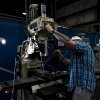
“If we want to see job growth that’s as strong for men as it is for women, we need to see men taking up these types of jobs as well,” says Stevenson.
So far, this has not happened in any meaningful way. Stevenson believes this is because men are more likely than women to identify with a particular occupation, making it harder for them to find work outside that field, much less in a field dominated by women.
Meanwhile, in his second term, Trump has not strayed from his message that manufacturing will make the country stronger. This is something he emphasized in his second inaugural addressDeclaring that “America will once again be a manufacturing nation,” and in his repeated promises that tariffs would “bring factories back to life again.”
When manufacturers added 15,000 jobs in March, the White House called it evidence that “The best days are still ahead for American workers, manufacturers and families,” despite the fact that the sector is still down 82,000 jobs since Trump took office.
“We’ve seen a year from a president who was completely focused on growing manufacturing,” Stevenson says. “Overall there aren’t enough jobs for men to move into.”

Emphasis on policies that open doors for men
What’s happening now in the labor market is no surprise to Richard Reeves, president of the American Institute for Boys and Men, a nonpartisan think tank.
He says that the shortage of men in some professions has not been given enough attention and now we are seeing the consequences of this.
“There’s no reason to panic here,” says Reeves, who has been studying the decades-long decline in labor force participation among men. “But I think we should be alert to signs that the labor market is moving even more rapidly in directions that are leaving too many men behind.”
Reeves notes that over the years, the country has adopted policies and programs aimed at getting more women into science, technology, engineering and mathematics, and the share of women in STEM jobs has increased.
“But this didn’t happen on its own. It happened as a result of concerted efforts to break gender stereotypes,” he says.
Still, shortcomings remain, and some of those efforts have seen their government funding cut under Trump.

Now Reeves says policies and programs are needed to attract male workers into fields like nursing, teaching and social work.
“They’re businesses that serve people and they should look like the people they serve,” he says. “And that’s good for men because it means they won’t lose those jobs if that’s where the growth is coming from.”
making jobs more masculine
Stevenson is thinking of ways to make the fastest-growing sectors of the economy more welcoming to men.
“I think we have a lot of ways of talking about those jobs being particularly masculine,” she says.
For example, many health care jobs may be designed as roles that require the strength to lift people. Preschools can highlight the need for teachers who serve as positive male role models.
“Kids love getting rough and making things,” she says.
Stevenson is aware that some people will be offended by such gender stereotyping.
“But I want to encourage us to realize that we have to help men understand that they can take on caring roles and remain masculine,” she says.
Ongoing challenges for women and men
Stevenson doesn’t want people to conclude that everything is OK now that women are moving into jobs.
“We know there is still discrimination that holds people back,” she says.

For women, she says, discrimination can prevent them from getting the promotions they deserve, contributing to widening the gender pay gap. For men, this may mean sitting on the sidelines because they don’t feel they have a role in the economy.
She says, “I think we can use this moment to realize that discrimination, occupational segregation…these are things that harm all of us, not just a narrow group.”
