


The US Capitol is visible at dawn on April 2, 2026.
Andrew Harnik/Getty Images
hide caption
toggle caption
Andrew Harnik/Getty Images
As the cost of the US-Iran war continues to rise by the day, the way has been paved for Republicans in control of Washington to pay for the conflict with a political threat.
The effort will begin in full swing when Congress returns from recess next week. The GOP faces an uphill battle over war funding, including challenges from within their own party as well as Democrats.
Complicating the path for Republicans is a host of unanswered questions about the war — from the cost of the conflict so far to how much the administration wants in additional war funding. The White House has not yet detailed any figures, but according to an estimate by the Center for Strategic and International Studies, the cost of the war so far has been estimated at about $30 billion.
And Republicans are on the clock, operating under the 1973 War Powers Resolution, which ends military operations after 60 without congressional approval. (However, the President may call for a 30-day extension).

In recent days, a growing number of GOP lawmakers have gone public with their concerns over the war — a number of issues the Republican leadership will be forced to address as they face the difficult task of securing new funding.
Senator Susan Collins, R-Maine, Criticized President Trump this week for his “provocative” war comments and called for a “swift” end to the conflict. Collins, who faces a tough re-election battle, said she would not vote for ground troops or to extend the conflict beyond 60 days “unless there is a dramatic change.”
“If the President conducts a ground attack, sends ground troops into Iran, I believe congressional authorization for such action is absolutely required under the War Powers Act,” Collins said. Said in a recent interview. “Or, if military hostilities last 60 days or more, then again, I think congressional approval is required.”

Senator Susan Collins, R-Maine, arrives for a Senate luncheon on February 25, 2026. Collins has said that boots on the ground in Iran would require congressional authorization.
Heather Diehl/Getty Images
hide caption
toggle caption
Heather Diehl/Getty Images
Other Senate Republicans have expressed similar concerns about the duration of the US commitment in Iran. This includes Senator John Curtis, R-Utah.
“I will not support military action lasting more than 60 days without congressional approval,” said Senator John Curtis, R-Utah. wrote last week The Deseret News. “I take this position for two reasons – one historical and one constitutional.”
Several liberal members have also said Trump’s Iran war could face a deadline without congressional approval, including Sens. Thom Tillis, R-N.C., Todd Young, R-Ind., and Rep. Don Bacon, R-Neb. and Mike Lawler, R.N.Y.
Young said that if the conflict drags on, Congress should resume its monitoring and policymaking role.

“The President intends for this to be a small operation, but as the conflict escalates, I urge Congress to become more involved in oversight and policymaking, including evaluating any potential requests for additional resources or providing additional authority,” Young said. Said Last month, Republicans blocked a Democratic-led Iran war powers vote.
Last month, Sen. Lisa Murkowski, R-Alaska, told reporters that the administration needs to be more transparent with Congress.
“The administration has to make a case. We are knowing through the media what is happening, but we are not getting public briefings,” he said.
a costly war
While lawmakers wait to see how much more money the administration can ask for the war, Republicans face several choices when it comes time to approve new funding. Republicans may try to approve additional funding through a supplemental funding proposal. Another option is to pass war funding through the reconciliation process, which would allow Republicans to bypass Democratic opposition.
Last week, the White House asked Congress to approve about $1.5 trillion for defense in the 2027 fiscal year, but it is unclear how much of that request will be tied to Iran.
“There are discussions about a supplement in the range of $80 to $100 billion, and that would cover the cost of the war,” said a senior adviser at the Center for Strategic and International Studies, who has worked on estimating the war’s price tag.
Cancian says the costly weapons systems and damage to US aircraft and military infrastructure are the biggest causes of the war, estimated at $29 billion so far. Washington Post Recently news has come that America has fired more than 850 Tomahawk cruise missiles. Cancian notes that Tomahawks have produced more bullets than any other war in American history, at $3.6 million a pop.
Because it could cost the United States an estimated $1 billion in military jets and other aircraft, Cancion said. And the dramatic rescue of two American airmen in Iran – in which several of their planes were destroyed – may have cost $500 million.

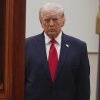
President Trump answers questions during a White House press conference about Iran on April 6, 2026.
Andrew Harnik/Getty Images
hide caption
toggle caption
Andrew Harnik/Getty Images
With razor-thin majorities in both the House and Senate, Republicans cannot afford many defections. Some people have already explicitly objected to the war and are expected to oppose funding.
It includes Senator Rand Paul and Representative Thomas Massie, both fiscal conservatives from Kentucky. For example, Paul has co-sponsored Democrat-led measures to limit Trump’s war powers in Iran, Venezuela and other conflicts.
where do the democrats stand
Meanwhile, Democrats aim to thwart funding and repeatedly put Republicans on the record on the war in an election year. On Thursday, House Democrats tried unsuccessfully to force a vote to limit Trump’s war powers in Iran. Next week, both House and Senate Democrats are expected to press for additional votes on war powers.
Senate Minority Leader Chuck Schumer, D-N.Y. “No president, Democrat or Republican, should lead this country into war alone. Not now, not ever,” Trump told reporters this week. “Republicans will once again have the opportunity to join Democrats and end this reckless war of choice. The public must demand that Republicans join with us to approve the War Powers Act.”
Many Democrats have tried to combine their criticism of the war with another issue that is expected to dominate this fall’s campaign: affordability.
“Gas prices are skyrocketing, the cost of living is out of control and billions of taxpayer dollars are being wasted by bombing Iran while Republicans refuse to spend a dime to make life more affordable for everyday Americans,” said House Minority Leader Hakeem Jeffries, D-N.Y.

House Minority Leader Hakeem Jeffries, D-N.Y., speaks to reporters on his way to his office on March 27, 2026. Democrats have tried to link criticism about the war in Iran with broader concerns about affordability.
Samuel Coram/Getty Images
hide caption
toggle caption
Samuel Coram/Getty Images
In addition to the direct government costs of the war, American families are expected to face indirect costs on fuel, groceries, travel, and more. That has given Democrats more fodder during the campaign this year.
Roger Pielke Jr., a senior fellow at the American Enterprise Institute, a conservative think tank, said gasoline and diesel price increases starting April 1 could cost Americans a total of $12.1 billion, or $92 per household. Pielke estimated that increases in jet fuel over the same time could add another $2.2 billion through higher airfares for passengers.
Meanwhile, U.S. farmers could pay an additional $131 million to cover higher fertilizer costs, which will eventually be passed on to food consumers, Pielke said.

Pilke said, “There has been some discussion and debate over the cost of the war to the federal government. Taxpayers pay it and that’s the real money.” “But it turns out that the costs are much higher than that and spill over into the economy because of the effects of the war, which are most visible on the Strait of Hormuz.”
But even as Democrats try to capitalize on rising costs caused by the war, the party faces its own internal divisions. Last month, Senator John Fetterman, D-Penn., and Representatives Henry Cuellar, D-Texas, Juan Vargas, D-Calif., and Jared Golden, D-Maine, all voted against limiting Trump’s Iran war powers. However, like his GOP colleagues, that support may shift for some after Congress returns next week.
Still, if the GOP remains united behind Trump they may be in no position to stop Republicans’ war funding efforts.
“You’ve already seen Democrats complaining loudly about the lack of transparency in the Pentagon briefing and saying it doesn’t have enough detail. Of course, they’ve complained about the lack of authorization for the use of military force,” Cancion said. “And (the cost) will drive it higher. But as long as the president can keep Republicans in check, there’s not much the Democrats can do.”
