


For nearly three years, the artificial intelligence (AI) narrative revolved around a key piece of hardware: the graphics processing unit (GPU). Now, as hyperscalers accelerate their data center build-outs, investors are realizing that GPUs are just one layer in the AI chip stack.
Memory chips and other data storage devices are integral parts of GPU clusters, and their demand has increased. As a result, over the past year, shares of the flash memory specialist SanDisk (SNDK +6.89%) There has been an increase of more than 1,600%.
Yet based on the headwinds fueling Sandisk’s business, I think the stock’s rally could be just getting started. In my view, it can easily reach further multibagger Returns from here.
today’s change
(6.89%) $42.67
current price
$661.49
key data points
market cap
$98B
day limit
$623.51 -$671.39
52wk range
$27.89 -$725.00
volume
465K
average volume
17m
gross margin
34.81%
Why is memory important for AI models?
During the AI revolution, growth investors have primarily focused on two aspects of the AI market: GPU designers such as NVIDIA And advanced precision instrumentsand cloud infrastructure providers such as Microsoft, AmazonAnd alphabet.
Businesses providing memory and data storage were largely undervalued because those products were viewed as corroding. Rival offerings lacked much differentiation, and their sales approaches often depended on upgrade cycles in the consumer electronics market. However, that narrative is beginning to change.
High-performance computing is not supported by processing power alone. As AI models become larger, large tech companies will have to make additional investments in the management capacity of their data centers estimate workload – In other words, the processing tasks involved in using trained models to make predictions and decisions based on real-world data.
These workloads are incredibly memory-intensive, as they require large amounts of data to be rapidly accessible. As such, Sandisk’s high-speed NAND flash storage chips are becoming essential for AI servers.

Image Source: Getty Images.
What is Sandisk’s addressable market?
The NAND flash memory market is expected to grow from approximately $59 billion in 2026 to $76 billion by 2031 – a 5.3% compound annual growth rate. On the surface, this growth rate may not seem exciting. However, consider that during Sandisk’s second quarter of fiscal 2026 (which ended Jan. 2), 85% of the company’s revenue came from its consumer electronics segment and its Edge segment (which makes memory for devices like PCs and smartphones). The subtle winner in the company’s latest earnings report was its data center division – which grew faster than its other business lines at 64% quarter over quarter.
But with only $440 million in quarterly data center sales — compared to $2.6 billion for its edge and consumer electronics segments — Sandisk is clearly still in the early stages of entering the AI data center market. Its data center opportunity is poised for explosive growth as demand for NAND flash storage increases.
Furthermore, given the limited competitive dynamics in the memory space – micron, SK HynixAnd SAMSUNG There are other main players – Sandisk should be able to command some level pricing power Because it continues to attract enterprise and hyperscaler customers.
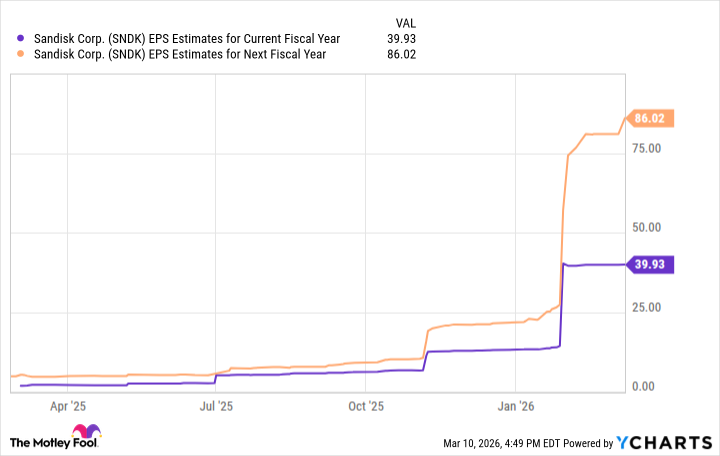
SNDK EPS Estimates for the Current Fiscal Year by data YCharts.
Wall Street appears bullish on Sandisk’s ability to maintain strong profit margins. Analysts’ consensus is that earnings will double over the next two years as the company rides the secular tailwind of the AI supercycle.
How high can Sandisk stock go?
While Sandisk’s stock is moving very quickly, looking at its percentage gain in isolation doesn’t tell us much about the company’s underlying valuation profile. Currently it is trading at 1 forward price-to-earnings (P/E) multiple of 15.5.
It is at a huge discount compared to other category-defining AI chip stocks. Nvidia, AMD, and broadcom The AI revolution has seen forward P/E ratios above 40 during previous bull cycles.
That said, measuring Sandisk against those companies is like comparing apples to oranges. GPU and AI accelerator designers are more versatile, general-purpose players in generic AI development. Sandisk’s expertise in flash storage – while significant – is more niche. Therefore, the addressable market of the company is not that large.
I think it’s more appropriate for Sandisk to be compared to tech-heavy Nasdaq 100 The index, which has a Forward P/E of around 24. If the market raises Sandisk’s valuation so that it trades in line with the index, it could reach a price of around $1,000 per share by the end of the year. This will result in a profit of more than 50% from the current price.
Wall Street is greatly underestimated Planned Capital Expenditures of Hyperscalers For 2026, I think Sandisk is strategically positioned for higher growth than expected this year. The stock’s upside could be much more than 50%.
The company’s data center business is poised for liftoff and with its huge opportunity in NAND flash storage, Sandisk stock could potentially double in 2026 should the company exceed Wall Street expectations – which I think is highly probable.