


As I write this, nine US companies have a market capitalization of $1 trillion or more. Most of them are from technology and technology-adjacent sectors, which are experiencing unprecedented growth thanks to emerging industries like artificial intelligence (AI).
Oracle (ORCL 2.60%) The giant was on the verge of joining the $1 trillion club last year when its market cap briefly topped $940 billion, but its valuation has fallen to about $480 billion after a 49% decline in its stock price.
Oracle is building some of the best AI data center infrastructure in the world, but there are concerns about its growing debt, and also that some of its largest customers will not be able to fulfill their large orders for computing capacity. Fortunately, the company’s recent operating results for the third quarter of fiscal year 2026 (ending February 28) put some of those concerns behind us.
Can Oracle stock rebound from here and reach the $1 trillion club once again?
Image Source: Getty Images.
Industry leading AI infrastructure
aye Development requires a substantial amount of computing power, which is why much of it takes place inside large, centralized data centers. They contain thousands of specialized chips called graphics processing units (gpu), which are mainly supplied NVIDIA And advanced precision instruments. Most businesses cannot afford to build this infrastructure in-house because it costs billions of dollars, so they choose to rent it from cloud providers like Oracle.
Oracle’s data centers are among the best in the world. They use the company’s proprietary Remote Direct Memory Access (RDMA) networking technology, which transfers data between chips and devices more quickly than traditional Ethernet networks. Most AI developers pay for cloud computing capacity by the minute, so faster processing speeds can result in substantial cost savings in the long run.
Oracle’s infrastructure also offers tremendous scale, allowing developers to activate more than 100,000 of Nvidia’s GPUs to run the most powerful AI models. As a result, some of the top players in the AI industry are lining up to access Oracle’s data centers OpenAI, meta platformAnd Elon Musk’s xAI.
Oracle Cloud Infrastructure’s revenue growth is accelerating
Oracle made $17.2 billion in total revenue during the third quarter of its fiscal year 2026, an increase of 17% from the year-ago period. But revenue from the Oracle Cloud Infrastructure (OCI) segment in particular increased 84% to a record $4.9 billion.
The OCI segment could grow even faster, but Oracle can’t build data centers fast enough to meet the demand from AI developers. In fact, it ended the third quarter with a whopping $553 billion in remaining performance obligations (RPO), which is more than four times Year after year. RPO is like an order backlog, which reflects the value of signed contracts for services that have not yet been delivered. Therefore, it is a good indicator of future potential revenue.

today’s change
(-2.60%) $-4.13
current price
$155.03
key data points
market cap
$446B
day limit
$154.15 -$160.77
52wk range
$118.86 -$345.72
volume
1.1m
average volume
-29M
gross margin
64.30%
dividend yield
1.29%
But there are concerns about the structure of Oracle’s RPO. last September, wall street journal It was reported that the company’s $300 billion backlog was due to ChatGate creator OpenAI alone, which is effectively a start-up. OpenAI has annual revenues of just $25 billion, and is losing money by the truckload, so there are legitimate questions about whether it can really meet its commitment to rent $300 billion worth of computing capacity.
These concerns are heightened by the fact that Oracle is financing the construction of some of its data centers using debt, so there could be serious consequences if its customers fail to turn up. These are the main reasons why its stock has fallen from last year’s peak.
Will Oracle Be the Next Trillion-Dollar Tech Stock?
Oracle earned earnings of $5.57 per share over the last four quarters based on generally accepted accounting principles (GAAP), its stock is placed at a Price-to-Earnings (P/E) Ratio Out of 29.5 as I write this. this is a little discount Nasdaq 100 The index, which trades at a P/E ratio of 30.9, suggests that Oracle may be undervalued compared to its peers in the technology sector.
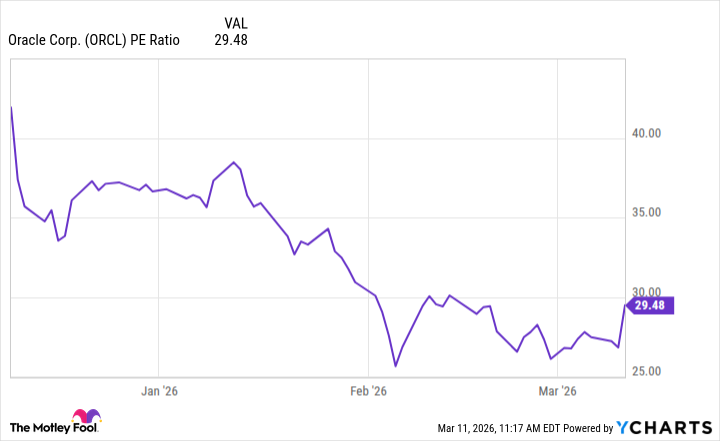
ORCL PE Ratio by data YCharts
If we assume Oracle’s P/E ratio remains constant, the company would have to grow its annual earnings by 108% to take its market capitalization from $480 billion to $1 trillion. For some perspective, Oracle’s earnings grew 17% during fiscal 2025, and they’re on track to grow another 32% in fiscal 2026. This means that even at the current pace of 32%, it will take about three years to generate enough earnings growth to justify a trip to the $1 trillion club.
However, Oracle It may be in the best position to achieve a trillion-dollar valuation before any other US tech stock currently floating around. micron technology It’s the next biggest technology company in line, but given its current valuation of $450 billion it has a lot of ways to go. even Palantir TechnologiesWhich is a growth force, with a current market capitalization of $360 billion is down significantly.
However, some non-technology companies are likely to get there before Oracle. pharmaceutical giant Eli Lilly It is currently valued at $900 billion, and the investment bank JPMorgan Chase Is worth 775 billion dollars.