


A small federal agency charged with protecting the public from injuries caused by lawn mowers and coffee makers is demanding that some of the nation’s largest health systems produce detailed, individually identifiable medical records of all patients who seek help in their emergency rooms.
The Consumer Product Safety Commission, which is responsible for tracking and recalling dangerous products sold in the U.S., began discreetly pressuring hospital executives this year for sharing personally identifiable health data with a private contractor. But hospital lawyers and other industry experts have raised questions about the agency’s authority to collect, its ability to safeguard such large amounts of sensitive information and whether it followed the legal process to overhaul its surveillance systems.
After KFF Health News asked CPSC about the new system. announced the agency Program on 21st July. However, the concern it raised among hospital officials and the nature and extent of the agency’s data demands were not mentioned.
In a sharp departure from its product-focused mission, the agency aims to obtain the medical records of millions of Americans for most injuries ranging from emergency room visits to broken bones to childhood vaccine reactions or even suicide attempts, according to documents and emails obtained by KFF Health News, as well as interviews with five people involved in or familiar with the discussions.
A CPSC official also emphasized in the email that institutions provide all ER patients’ identifiable information — such as name, address, diagnosis and other personal details — to the contractor, Konza Health, for analysis. in correspondence with hospital officialsKonza representatives described participation as “mandatory” or “essential”.
As a condition of viewing the correspondence, KFF Health News agreed not to republish some of the emails it received.
The CPSC wants at least 100 hospitals to start sending detailed medical records by the end of this year, according to one internal memo.
“The whole thing is troubling,” said Sharona Hoffman, a health law professor at Case Western Reserve University, who said giving a private entity access to such a broad collection of data would pose a risk to patient privacy. “If this company is indeed collecting identifiable information, it is concerning for patients.”
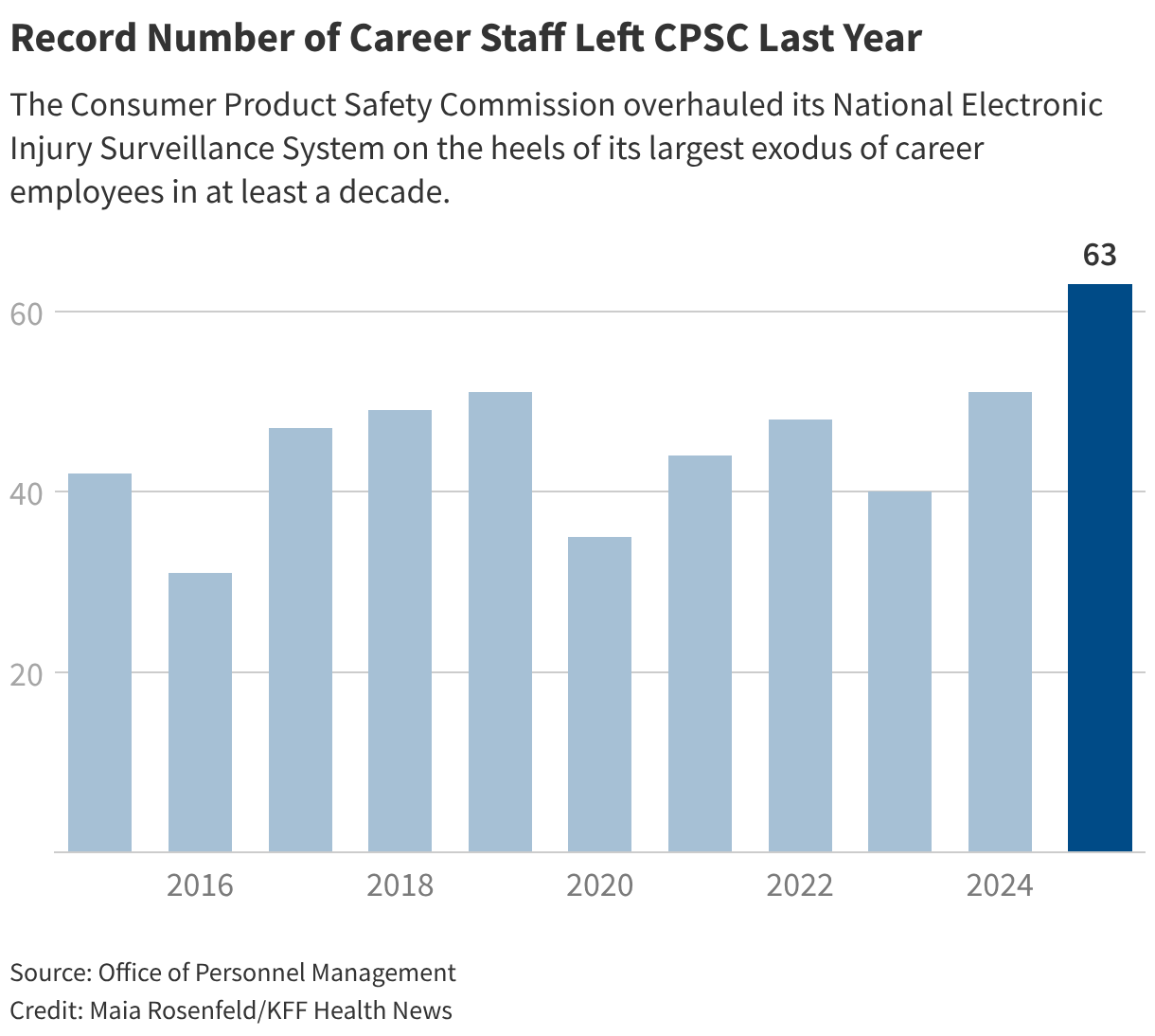
The new project was launched amid turmoil at the traditionally independent agency, which is without a governing board after President Donald Trump fired the CPSC’s three Democratic board members. Nearly 1 in 5 career employees left the CPSC in the first 16 months of the new administration, according to a KFF Health News analysis of federal workforce data.
The initiative also comes as the Trump administration has sought unprecedented access to the medical records of millions of Americans, the Office of Personnel Management has requested sensitive health information of federal employees and Health and Human Services Secretary Robert F. Kennedy Jr. has tapped a private organization to gather more medical records for his study on vaccines and autism.
CPSC spokesman Steve Roney said in an email statement July 10 that the CPSC is “modernizing” its surveillance system. Asked whether the CPSC would file complaints against hospitals that did not participate, he said only that while the previous system “operated as a voluntary program, the ability of hospitals to opt out limited the sample size and usefulness of the data.”
Roney also acknowledged that the agency had not yet informed the public, as “required by law.”
Federal law requires the agency to provide notice and a public comment period before requesting information from 10 or more entities, a step that has not been taken despite plans to include 100 hospitals in the monitoring system. KFF Health News independently confirmed to more than a dozen hospitals that they were contacted.
federal public health authority cannot be ordered legally That personal health data be reported. But CPSC officials have Publicly and privately suggested If hospitals refuse to share data with the new surveillance system, they could be subject to stiff penalties under the data-sharing regulation, known as “information blocking.”
Yet some hospital executives say they are reluctant to share patients’ sensitive data because they are worried about a different breach — that is. federal privacy laws.
AI took over
Dozens of ERs across the country already participate in CPSC’s voluntary National Electronic Injury Surveillance System, or NEISS, through which trained hospital staff report injuries linked to consumer products, almost always stripped of patients’ identifying information. This system helps CPSC identify products such as baby loungers, toys, and home appliances that contain patterns that could hurt consumers.
The new injury monitoring program goes a long way.
At a toy industry trade event in February, acting CPSC Chairman Peter Feldman said the agency is “investing in AI-enabled workflows that improve the quality and quantity of injury surveillance data, while also building digital infrastructure to handle a vast new volume of electronic health records.”
Konza Health, a Kansas-based organization that runs the state’s health data exchange, will automatically pull and analyze medical records of all patient visits from ERs across the country. konza won five year contract Last time its price with the CPSC reached $15.9 million.
In email correspondence with hospital technology executives, Konza Health President and CEO Laura McCrary also described ERS’ involvement as “essential,” adding that they share patient records with identifying information.
McCreary told KFF Health News by email that the company is not using AI to process the records it receives, instead Konza will use “advanced analytic parsing and filtering capabilities.” CPSC spokesperson Roney did not answer questions about this. use of ai.
Over the years, agency officials have discussed Moving away from human contractors and automating NEISS to save time and money.
But without on-site staff, hospital staff may not receive training to determine what clinical information is important to include for the CPSC. In short, the changes could weaken the quality of product safety data collected by the agency.
“They want to suck up as much data as possible, but I’m not sure how thoughtful they are about what’s collected and what the agency actually needs,” said former CPSC Chairman Alexander Hoehn-Sarik, one of the Democratic appointees whom Trump fired last year.
Wanted: Injuries from vaccines and stingrays
CPSC’s new data collection appears to contradict its own 214-page operating manualWhich directs hospitals not to include identifying information “such as names, dates of birth or addresses” when reporting cases.
According to the manual, the agency should obtain patients’ identifying information only when follow-up testing is needed, which is less than 1% of reported cases.
The CPSC has also historically limited the records it collects to reduce privacy violations in the case of a data breach.
The risk is not imaginary: From 2017 to 2019, the agency improperly released the personal health information of nearly 30,000 people, a revelation that a top Republican at the time Called “related”.
However, Konza will receive even more sensitive information about many more people. McCreary said in a statement that Conza would remove patients’ names, addresses and medical information “not required by CPSC” before sharing records with the agency.
Leaving it to a private organization to collect sensitive information creates risks, including that it could be stolen or used for commercial purposes, said Hoffman, the Case Western professor.
“Often, they will use the information for marketing because now they know what people’s situations are,” she said.
Roney said its contract with Konza, which has not been made public, prevents the organization from selling or marketing the data it collects.
The CPSC’s manual also identifies the types of ER visits that should not be reported to the CPSC, which has jurisdiction only over certain consumer products. Excluded injuries are those caused by food, illegal drugs, medical devices, alcohol or plants, as well as injuries that do not involve consumer products – such as a cut from a rock or broken bones from falling to the ground – and suicide attempts by adults.
but in a contract offered At one hospital and reviewed by KFF Health News, Konza set no such limits on the information it collects from ER records and said it would retain patient health information for at least 30 days.
In an email sent to hospital technology executives, McCrary wrote that Conza will provide records to CPSC when a patient is treated in the ER for more than 10,000 conditions. The comprehensive list of diagnostic codes Conza provided in the email includes injuries that do not involve consumer products.
Child injuries caused by “poisoning” by vaccines or by exposure to stingrays, neither of which are regulated by the CPSC, are included in the list.
A limited number of hospitals once shared anonymized data on all injuries — regardless of product involvement — through NEISS using the injury-tracking program of the Centers for Disease Control and Prevention. But CDC halted that data collection after funding and staffing cuts last year, and has not resumed it.
pressure on hospitals
CPSC Chief Data Officer Elizabeth Puchek, who joined the agency late last year after engineering data systems for U.S. Citizenship and Immigration Services, told hospitals in an email that they would have to waive the program if they refuse to share patients’ emergency room records with Conza.
CPSC’s targeted outreach includes some of the nation’s largest urban and rural health systems as well as smaller, publicly owned hospitals.
Staff members at Mary Greeley Medical Center in Ames, Iowa, said Konza and federal officials told them that their participation in the new program was mandatory. The hospital, which has long participated in NEISS, signed a new contract in April to share its ER records with Konza.
Yet the hospital is reevaluating its participation after being informed that the funding it received to participate in NEISS “is no longer available,” said spokesman Steve Sullivan.
Many hospital officials, lawyers, and others have expressed skepticism about the CPSC’s claimed authority.
Harborview Medical Center spokeswoman Susan Gregg said the Seattle hospital’s emergency room “has voluntarily submitted de-identified data for several years, but we are not obligated to report this information.”
In Boston, Mass General Brigham has declined to participate in the new program, with spokeswoman Kelly Mitchell saying that “to protect patient privacy, we are unable to provide these medical records.”
Henry Ford Health in Detroit; St. Luke’s in Boise, Idaho; and Sanford Health, based in Sioux Falls, South Dakota — which together handle more than one million ER visits a year — are among the health systems that have been contacted but have not yet reached an agreement with Konza, according to representatives. Several of the nation’s busiest hospital systems targeted for the program — including Mayo Clinic in Minnesota, Yale New Haven Hospital in Connecticut, Nationwide Children’s Hospital and Cleveland Clinic in Ohio, and Baylor Scott & White Health in Texas — declined to answer questions about whether they were participating.
Hoehn-Sarik, the former chair of the agency, said she was surprised that the CPSC would insist that hospitals provide deidentified records from all emergency room visits.
“The idea that they can simply ask a hospital for patient information and the hospital will provide it — I don’t really understand the basis of it,” he said.
